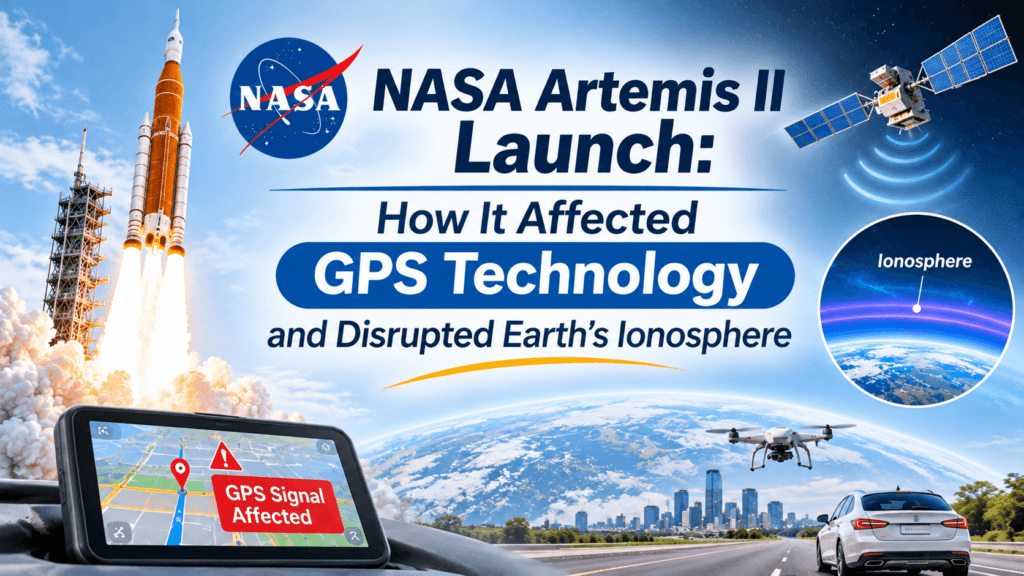
The Artemis II launch disturbed Earth’s ionosphere enough to cause a temporary GPS disruption.
A new study found that NASA’s rocket punched two huge disturbances into Earth’s ionosphere that stretched about 3100 miles across the United States. Those changes were big enough to throw GPS positioning off by several meters.
When most of us watched the NASA Artemis II launch in April 2026 we were glued to the astronauts. Four people were heading around the Moon for the first time in more than 50 years. Nobody was thinking about the map app on their phone.
But high above our heads something else was going on. The rocket was stirring up Earth’s upper atmosphere in a way that scientists are only now starting to measure.
A few meters might not sound like much. You would barely notice it while driving to the grocery store. For a self driving car choosing a lane or a drone landing on a porch it is a much bigger deal.
In this post we walk through what happened and how it works and whether we should worry about rocket launch GPS interference as missions to the Moon and Mars pick up speed.
What Happened During the NASA Artemis II Launch?
NASA launched Artemis II on April 1 2026 from Kennedy Space Center in Florida. The giant Space Launch System rocket carried four astronauts inside the Orion spacecraft on a loop around the Moon.
It was the first time humans had traveled to the Moon’s neighborhood since the Apollo era. It was also a dress rehearsal for future landings.
That alone made it one of the biggest space stories of the year. Then researchers noticed something nobody had planned for.
As the SLS climbed through the sky it disturbed the ionosphere. That is the electrically charged layer of Earth’s upper atmosphere. The team spotted two massive disturbances spreading roughly 3100 miles or 5000 kilometers across the country.
These disturbances changed the number of free electrons floating in that layer. GPS signals have to pass right through it on their way down to us. So when the layer changes the signals change too.
Put simply the rocket briefly reshaped the path that our navigation signals travel.
How Did Artemis II Create an Ionosphere Disturbance?
To get this we need to picture what a rocket like the SLS really does on its way up.
It does not glide like a plane. It tears through layer after layer of atmosphere at incredible speed. Along the way it throws off powerful shock waves that shove the surrounding air around.
Scientists call some of these ripples traveling ionospheric disturbances. On top of that the rocket’s exhaust can wipe out free electrons in certain spots of the ionosphere.
The result looks a lot like a hole in the charged upper atmosphere. Think of dragging your hand quickly through a still pond. You leave a gap behind and ripples spread out for a long way.
Disturbance one: the core stage climbs
The first disturbance trailed the rocket’s core stage. That piece alone is about 212 feet or 65 meters tall.
As it powered upward its shock waves rippled outward and shook up the conditions around it.
Disturbance two: the upper stage fires
The second disturbance came from two engine burns by the upper stage. Those burns happened about 115 miles or 185 kilometers above Earth. They are what pushed Orion out of Earth orbit and toward the Moon.
Here is the surprising part. The upper stage burns caused an even stronger disturbance than the launch itself.
Why? Because those burns happened right inside the ionosphere. The rocket was not just passing through. It was firing its engines in the middle of the very layer GPS signals depend on.
Both disturbances spread across thousands of miles. That is a huge footprint for a single launch.
Why Earth’s Upper Atmosphere Matters for GPS
The ionosphere starts around 30 miles or 50 kilometers up and stretches far out into space. It is packed with free electrons and charged particles. Those particles interact with every radio signal that passes through.
That includes the signals from GPS satellites.
How GPS actually finds you
Your phone does not magically know where you are. It works it out with timing:
- Each GPS satellite sends a signal with a precise timestamp.
- Your receiver measures how long each signal took to arrive.
- It turns that travel time into a distance.
- With signals from at least four satellites it can pin down your location and fix its own clock.
The catch is that those signals do not fly through empty space the whole way. They have to cross the ionosphere first.
When the number of free electrons changes the signals slow down or speed up slightly. Your receiver does not know that. It just sees a different travel time and calculates the wrong distance.
A tiny timing slip turns into GPS positioning errors you can measure in meters.
Where a few meters really matter
Most of us use GPS without a second thought. We type in an address and follow the blue dot. If it is off by a few meters we never notice.
Machines that act on their own are a different story:
- Delivery drones need to hit a specific backyard and not the neighbor’s pool.
- Farm tractors guided by GPS follow tight rows so they do not plant or spray the same strip twice.
- Surveyors rely on precise readings to map property lines and track ground movement.
- Ships and aircraft use satellite positioning for key navigation tasks.
- Self driving cars need to know which lane they are in.
GPS is not just about finding the nearest coffee shop anymore. A lot of modern tech quietly depends on it being right.
Self Driving Cars GPS Accuracy: Should We Worry?
This is the part of the study that got tech fans talking.
Earth science professor, Charles Lin at National Cheng Kung University in Taiwan and a coauthor of the research. He pointed out that positioning errors of a couple of meters could affect the choices an autonomous vehicle makes.
Picture a robo taxi cruising down a busy four lane highway at rush hour. Its software thinks the car is centered in lane two. In reality it is drifting toward lane three. That gap is roughly the width of half a lane.
Now the car has to decide whether to merge or take an exit. A wrong read on its position could make that call messier.
Why it probably did not cause crashes
Before anyone panics we should keep this in perspective.
Modern autonomous cars do not rely on GPS alone. They stack several systems on top of each other:
- Cameras that read lane lines and road signs
- Radar that tracks nearby vehicles
- Lidar that builds a 3D picture of the surroundings
- Onboard motion sensors that track speed and direction
If GPS drifts the other sensors can fill in the gap. Drones work in a similar way with extra sensors that help keep them steady.
The study shows a possible risk. It does not report any real crashes or widespread failures caused by Artemis II. Researchers measured atmospheric changes that equal a few meters of GPS error. They did not link the launch to any car or drone accident.
That difference matters. It is a heads up for engineers and not a reason to stop trusting your navigation app.
Artemis II vs. Starship: A Surprising Comparison
This is where the study gets really interesting for rocket fans.
The researchers compared Artemis II with other launches. Some of its ionospheric disturbances were up to ten times stronger than those seen after SpaceX Starship test flights.
That sounds backward at first. Starship produces about twice the liftoff thrust of NASA’s SLS. So how did the smaller punch leave the bigger mark?
It is not just about liftoff power
The answer comes down to where the engines fire.
- Starship test flights so far have mostly stayed on suborbital paths.
- Artemis II fired its upper stage twice while sitting right inside the ionosphere.
- Those high altitude burns disturbed the charged layer directly instead of from below.
So the lesson is simple. To understand a rocket’s effect on the atmosphere we need to look at its whole flight and not just the fireball at the pad.
If you have been following Starship’s ups and downs we covered its latest test in Starship Test Ends in Explosion: Is SpaceX Still on Track? It is a good companion read to this one.
How Scientists Spotted the GPS Disruption
The research team did not launch any special equipment. They used something that already existed.
Across the United States there are networks of high precision GPS receivers on the ground. Scientific groups normally use them to track tiny shifts in Earth’s surface. They help monitor tectonic plates and study the kind of ground movement linked to earthquake risk.
The team realized these same receivers could act as atmospheric sensors. Here is how it worked:
- They measured how long signals took to travel from GPS satellites to each receiver.
- They compared those travel times across the network.
- From the differences they estimated changes in the ionosphere’s total electron content.
- That let them rebuild a picture of the disturbances the rocket left behind.
We love this approach. It turns a tool built for earthquakes into a tool for studying space weather and rockets. The findings appeared in a research preprint connected to the journal Geophysical Research Letters.
Rocket Launch GPS Interference vs. Solar Storms
So are rockets now the biggest threat to GPS? Not really. The Sun still holds that title.
The Sun regularly blasts charged particles toward Earth. When they hit our magnetic field and upper atmosphere they can scramble the ionosphere on a massive scale. A strong solar storm can throw off GPS and radio signals for days.
Rocket disturbances are usually much shorter. What makes the Artemis II finding important is that it proves human activity can shape the same layer our signals rely on.
Here is how the two compare:
| Rocket launch disturbances | Solar storm disturbances | |
| Objective | Shock waves and engine burns | Charged particles from the Sun |
| Impact on the atmosphere | Changes electron levels along the flight path | Disturbs the ionosphere on a global scale |
| GPS | Short positioning errors of a few meters | Can cause major navigation errors |
| How long it lasts | Usually short | Can last for days |
| Area covered | Can stretch across thousands of miles | Can affect huge parts of the planet |
Both deserve attention. GPS now sits underneath banking systems and power grids and emergency services as well as our maps.
What This Means for Future Moon and Mars Missions
Artemis II was a test run for bigger things. NASA plans to land astronauts on the Moon again and eventually aim for Mars. Private companies are building heavy rockets of their own.
That means the sky is about to get a lot busier. In the coming years we can expect:
- More launches of heavy lift rockets
- More engine burns high up in the ionosphere
- Larger waves of commercial satellites
- Crewed missions to the Moon and later Mars
- Tighter launch schedules shared by many space agencies
Each of those adds to the stress on the upper atmosphere. Studies like this one help scientists improve GPS correction models and predict disturbances before they happen. They also help engineers build navigation systems that stay steady when the atmosphere gets choppy.
To be clear this is not a case for grounding rockets. It is a reminder that space exploration and atmospheric science need to grow up together.
Frequently Asked Questions
Did the Artemis II launch really disrupt GPS?
It changed the ionosphere enough to equal GPS errors of several meters. The study did not find widespread GPS failures or real accidents. If you worry about how much we lean on GPS that concern is fair but this was a brief blip and not a breakdown.
Did Artemis II actually punch holes in Earth’s atmosphere?
In a way yes. The rocket’s core stage and its upper stage burns created two large ionospheric disturbances. These were zones where the number of free electrons dropped or shifted over a wide area.
Can rocket launches affect self driving cars?
They could in theory. A shift of a few meters in GPS could confuse lane choices. Most autonomous cars also use cameras and radar and lidar so the risk is much lower in practice. It is natural to feel uneasy about this but these backup systems exist for exactly this reason.
Why does the ionosphere affect GPS accuracy?
GPS signals pass through the ionosphere before they reach us. When its electron levels change the signals arrive slightly early or late. Your receiver reads that as a different distance and your position shifts.
Will future Moon missions cause the same problem?
Probably. Powerful rockets that fire engines high in the atmosphere can create similar disturbances. Scientists are already working on better ways to track and predict them so our navigation tools keep up.
Conclusion: What the Artemis II Launch GPS Disruption Teaches Us
Artemis II will be remembered for sending astronauts back around the Moon after half a century. It also left a hidden mark much closer to home.
Researchers at National Cheng Kung University showed that the launch stirred up Earth’s ionosphere across thousands of miles. Those changes were large enough to equal GPS positioning errors of several meters.
Rocket launches can affect the upper atmosphere well beyond the immediate launch area. Engine burns within the ionosphere have a greater impact than the initial liftoff thrust. While a few meters of GPS error may seem minor to individuals it can significantly affect drones and self driving cars. Backup sensors help keep today’s autonomous systems safe during brief disruptions. As launch frequency increases scientists must continue to monitor atmospheric effects closely. This should not be interpreted as evidence that Artemis II disrupted GPS as it did not. Instead it demonstrates how space exploration can influence the technology we rely on daily.
As NASA and SpaceX and others aim for the Moon and Mars these findings will only become more important. Better models and smarter receivers will help keep our blue dot where it belongs.
For more easy to follow stories on space and science and the tech shaping our world keep reading All About Craze. We break down the big headlines so you can understand them in minutes.